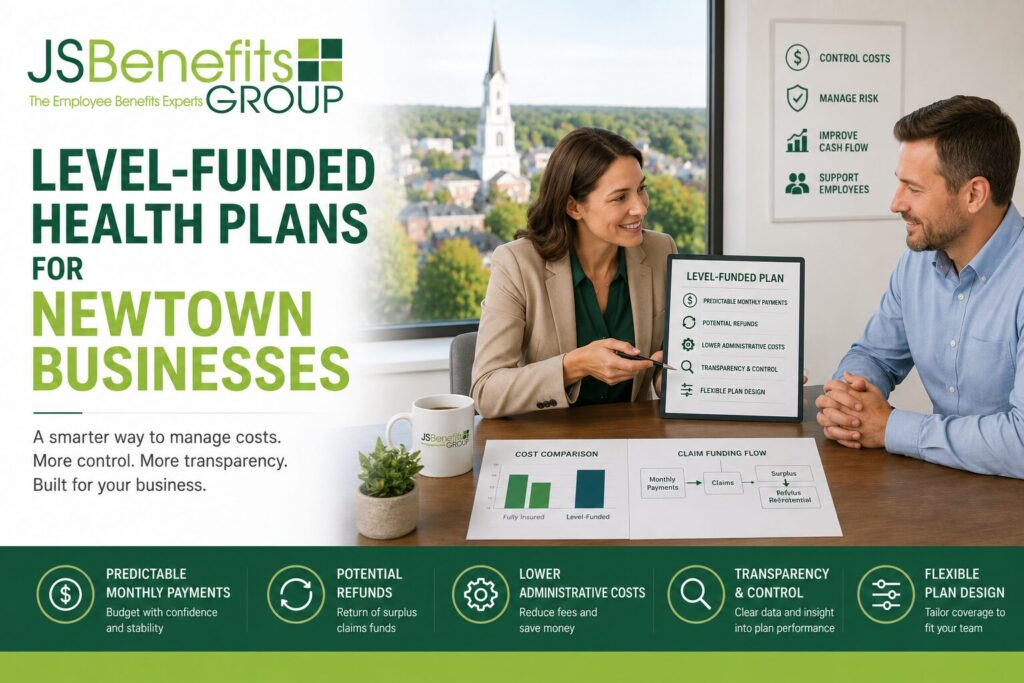

Quick Answer: A level-funded health plan gives Newtown businesses a fixed monthly payment with more cost transparency than many traditional fully insured plans. It may help employers control healthcare costs, review claims data, and possibly receive money back when claims are lower than expected. It can be a good fit for some small and mid-sized businesses, but employers should compare cost, risk, provider access, plan terms, and compliance needs before switching.
How Does a Level-Funded Health Plan Work?
A level-funded plan is built around a fixed monthly payment. This helps employers plan their budget because the monthly cost is predictable during the plan year.
Here is the basic idea:
| Part of the Plan | What It Does |
| Claims fund | Pays eligible employee medical claims |
| Administrative costs | Covers plan administration and related services |
| Stop-loss protection | Helps protect the employer from very high claims |
| Monthly payment | Keeps employer costs predictable during the plan year |
| Claims review | Gives the employer more insight into healthcare spending |
| Possible surplus | May return unused claims dollars if claims are lower than expected |
If your employees have lower-than-expected claims, your business may be eligible to receive part of the unused claims fund back, depending on the plan terms. If claims are higher than expected, stop-loss protection helps limit how much risk your company takes on.
This is why level funding can be attractive to employers that want more control but are not ready for a traditional self-funded plan.
How Is Level Funding Different From Fully Insured Health Insurance?
The biggest difference is who keeps the money and who sees the data.
In a fully insured plan, your business pays the insurance carrier. If your employees use less healthcare than expected, the carrier usually keeps the difference. You may also have limited insight into claims data, especially as a smaller employer.
In a level-funded plan, your business may have more access to claims reporting and may be able to benefit if claims are lower than expected. You still have predictable monthly payments, but you also get more information about how the plan is performing.
That added transparency can help employers make better decisions at renewal time.
For example, if prescription drug costs are driving the plan increase, your consultant may be able to review pharmacy benefit options. If certain plan features are underused, there may be a better design. If employees are choosing care inefficiently, stronger education may help.
A level-funded plan gives you more room to manage the plan instead of simply accepting a renewal increase.
How Is Level Funding Different From Self-Funding?
A self-funded health plan usually gives employers the most control, but it can also involve more risk and more administration.
In a traditional self-funded plan, the employer pays claims directly as they come in. That can work well for larger employers with enough cash flow, claims data, and risk tolerance.
A level-funded plan is often seen as a middle ground. It gives employers a fixed monthly payment, stop-loss protection, and more claims visibility than many fully insured plans.
For small and mid-sized employers in Newtown, that middle ground may feel more manageable. You are not jumping straight into full self-funding, but you may still gain more control over plan design, claims data, and cost strategy.
| Plan Type | Best For | Main Advantage | Main Consideration |
| Fully insured | Employers that want a simpler plan structure | The carrier takes on most claims risk | Employers may have less claims visibility and fewer savings opportunities |
| Level-funded | Employers that want predictable payments with more transparency | Fixed monthly cost, claims insight, and possible surplus return | Employers need to review risk, reporting, plan terms, and compliance responsibilities |
| Self-funded | Employers ready for more control and more responsibility | More flexibility over plan design and cost strategy | More risk, administration, and cash flow planning |
Why Newtown Employers Review Level-Funded Plans at Renewal
Many Newtown employers start looking at level-funded plans when their fully insured renewal increases and the current carrier does not provide enough visibility into what is driving the cost. Instead of simply accepting the renewal, employers may want to compare whether a level-funded option gives them better cost transparency, stronger plan design options, and a more practical long-term benefits strategy.
Small and mid-sized employers in Newtown, Bucks County, and the greater Philadelphia region are dealing with the same pressure many businesses face. Health insurance costs keep rising, employees still expect strong benefits, and business owners need to protect the bottom line.
A level-funded health plan may help some employers address these challenges.
It can give your business a clearer view of what is driving costs. It may also give you more flexibility to adjust plan design, review prescription spending, and make smarter renewal decisions.
For companies with relatively healthy employee groups, level funding may create savings opportunities. For companies with higher claims or more complex healthcare needs, it may still be worth reviewing, but it needs careful analysis.
Level funding is not automatically better. It should be compared against your current plan, employee needs, provider access, renewal terms, and long-term benefits goals.
When Might a Level-Funded Plan Be a Good Fit?
A level-funded health plan may be a good fit if your business wants more control over healthcare spending but still needs predictable monthly costs.
It may be worth reviewing if:
| Business Situation | Why Level Funding May Help |
| Your renewal increase is high | You may be able to compare alternative funding options |
| Your team is relatively healthy | Lower claims may create savings potential |
| You want more claims insight | Reporting may help you understand cost drivers |
| You need predictable monthly payments | Level funding keeps costs more stable during the plan year |
| You want more plan design flexibility | Some plans allow more control over deductibles, copays, and structure |
| You are outgrowing basic group health options | Level funding may offer a more strategic next step |
This does not mean every business should switch. It means level funding should be part of the conversation when your current plan is no longer working well.
If your renewal increase is high or your current plan gives you little insight into what is driving costs, it may be time to compare your options. JS Benefits Group can help Newtown employers review level-funded plans alongside fully insured and self-funded strategies before making a decision.
When Might Level Funding Not Be the Right Fit?
Level funding is not right for every company.
It may not be the best option if your business has very unpredictable cash flow, a small group with high healthcare usage, or employees with ongoing medical needs that could create higher claims. It may also be a poor fit if your team needs a very specific provider network that is not available through the level-funded options being reviewed.
You also need to be comfortable with more plan responsibility. Level-funded plans can involve more reporting, compliance, and decision-making than a basic fully insured plan.
The decision should come from a side-by-side review, not from the lowest quote alone.
What Should a Newtown Employer Review Before Choosing Level Funding?
Before moving to a level-funded health plan, your business should look at more than the monthly payment.
You should review your current plan, renewal increase, claims history if available, employee demographics, provider network needs, prescription drug usage, contribution strategy, and plan design options.
You should also ask how the plan handles surplus funds, high claims, stop-loss coverage, renewals, reporting, and compliance.
Important questions include:
- What is included in the fixed monthly payment?
- What happens if claims are lower than expected?
- What happens if claims are higher than expected?
- How does stop-loss protection work?
- Are my employees’ doctors and hospitals in network?
- What pharmacy benefits are included?
- What reports will the employer receive?
- What compliance responsibilities come with the plan?
- How will employees be educated during open enrollment?
- What happens at renewal if claims increase?
These questions can help you avoid choosing a plan based only on a lower first-year quote.
How to Compare a Level-Funded Quote Against Your Current Plan
A level-funded quote should not be judged by the monthly payment alone. Employers should compare the provider network, prescription coverage, stop-loss terms, claims funding arrangement, administrative fees, surplus rules, renewal method, and employee impact.
A lower first-year quote may not be the best choice if employees lose important provider access or if the renewal terms create more risk later. The stronger approach is to compare the current plan and level-funded option side by side so the business can understand cost, risk, access, and long-term fit.
This is especially important for Newtown employers with workers across Bucks County, Philadelphia, New Jersey, and nearby areas. A plan may look strong on paper, but employees still need practical access to doctors, hospitals, pharmacies, and care options they can actually use.
How Can Level Funding Help With Cost Control?
Level funding can help with cost control because it gives employers more visibility into how healthcare dollars are being used.
With better data, your business can make smarter choices. You may be able to see whether costs are driven by medical claims, prescription drugs, emergency room use, chronic conditions, or plan design issues.
That information can guide better decisions.
For example, your consultant may recommend plan design changes, employee education, pharmacy benefit review, wellness support, or alternative carrier options. The goal is to understand the real cost drivers instead of guessing.
Level funding can also create possible savings if claims are lower than expected. However, savings are not guaranteed. A careful review is needed before making the switch.
What Are the Compliance Considerations?
Level-funded health plans often come with additional compliance responsibilities because they are usually connected to self-funded plan rules.
Employers may need to pay closer attention to requirements related to plan documents, notices, reporting, ERISA, ACA, COBRA, and other benefits-related rules.
While a benefits consultant does not replace legal counsel, they can help employers stay organized, understand common benefits-related requirements, and identify areas that may need closer review.
This is one reason businesses should not choose level funding based only on price. The plan needs to fit the business from a cost, employee, administration, and compliance standpoint.
Is a Level-Funded Plan Good for Small and Mid-Sized Businesses?
A level-funded plan can be good for some small and mid-sized businesses, but it depends on the group.
For an employer with a relatively healthy workforce, stable employee count, and interest in better cost visibility, level funding may be worth exploring. It can offer predictable monthly payments, possible savings, and more insight into healthcare spending.
For a very small group with high claims, frequent employee turnover, limited HR support, or little comfort with additional plan responsibility, a traditional fully insured plan may still be a better fit.
The best approach is to compare both options side by side. That way, you can see the monthly cost, plan design, network, employee impact, risk level, and renewal expectations before making a decision.
Why Local Guidance Matters for Newtown Businesses
Health insurance decisions are not just about numbers. They are also about people.
A Newtown employer needs to think about where employees live, which doctors they use, whether they need access to providers in Bucks County, Philadelphia, New Jersey, or nearby areas, and how a plan change may affect families.
Local knowledge matters because provider networks and carrier options can vary by region. A plan that looks good on paper may not work well if employees lose access to preferred doctors, hospitals, or pharmacies.
This can be especially important for professional offices, contractors, healthcare practices, nonprofits, retailers, and service businesses in Newtown that need competitive benefits but may not have a large internal HR team.
A local benefits consultant can help review these details before you make a move.
For Newtown businesses, that can make the difference between a plan that saves money and a plan that creates frustration.
How JS Benefits Group Helps Newtown Employers Review Level-Funded Plans
JS Benefits Group helps employers in Newtown, Bucks County, and the surrounding region compare employee benefits options, including level-funded health plans, group health insurance, self-funded strategies, compliance support, and healthcare cost management.
The team does not simply look at the lowest quote. They review your current plan, renewal increase, workforce needs, provider access, contribution strategy, plan design, claims funding arrangement, stop-loss terms, administrative costs, and long-term goals.
Their process includes discovery, benefits analysis, benchmarking, strategy design, carrier market review, implementation, open enrollment support, and ongoing renewal guidance. That gives employers a clearer way to understand whether level funding is actually a smart fit.
If your business is dealing with rising premiums, a difficult renewal, or limited visibility into healthcare costs, a level-funded plan may be worth reviewing as part of a broader benefits strategy.
To learn more about this option, visit JS Benefits Group’s Level-Funded Health Plans page or schedule a benefits consultation to compare your current plan against available alternatives.
FAQs About Level-Funded Health Plans
What is a level-funded health plan?
A level-funded health plan is a group health plan where the employer pays a fixed monthly amount that helps cover claims, administrative costs, and stop-loss protection. It offers predictable monthly payments while giving employers more insight into claims and possible savings if claims are lower than expected.
Is a level-funded plan the same as self-funded insurance?
No. A level-funded plan is often considered a middle ground between fully insured and self-funded coverage. It has some self-funded features, but it usually includes fixed monthly payments and stop-loss protection to help limit the employer’s risk.
Can a level-funded health plan save my business money?
It can, but savings are not guaranteed. A level-funded plan may save money if claims are lower than expected or if the plan design better fits your workforce. Employers should compare the full cost, risk, network, and renewal terms before switching.
What happens if claims are higher than expected?
Level-funded plans usually include stop-loss protection, which helps limit the employer’s exposure to very high claims. The details depend on the plan, so it is important to review how the stop-loss coverage works before enrolling.
What happens if claims are lower than expected?
Depending on the plan terms, the employer may receive part of the unused claims fund back. This is one reason level-funded plans can appeal to businesses with healthier employee groups.
Get Help Reviewing Level-Funded Health Plan Options in Newtown, PA
A level-funded health plan can be a smart option for some Newtown businesses, but it should never be chosen based on price alone. The right plan needs to fit your employees, your budget, your provider needs, and your long-term goals.
JS Benefits Group helps employers compare level-funded plans, fully insured plans, self-funded strategies, and other employee benefits options with a clear focus on cost control, compliance, and employee support.
If your health insurance renewal is rising or you want to understand whether level funding is right for your business, schedule a free benefits analysis with JS Benefits Group.