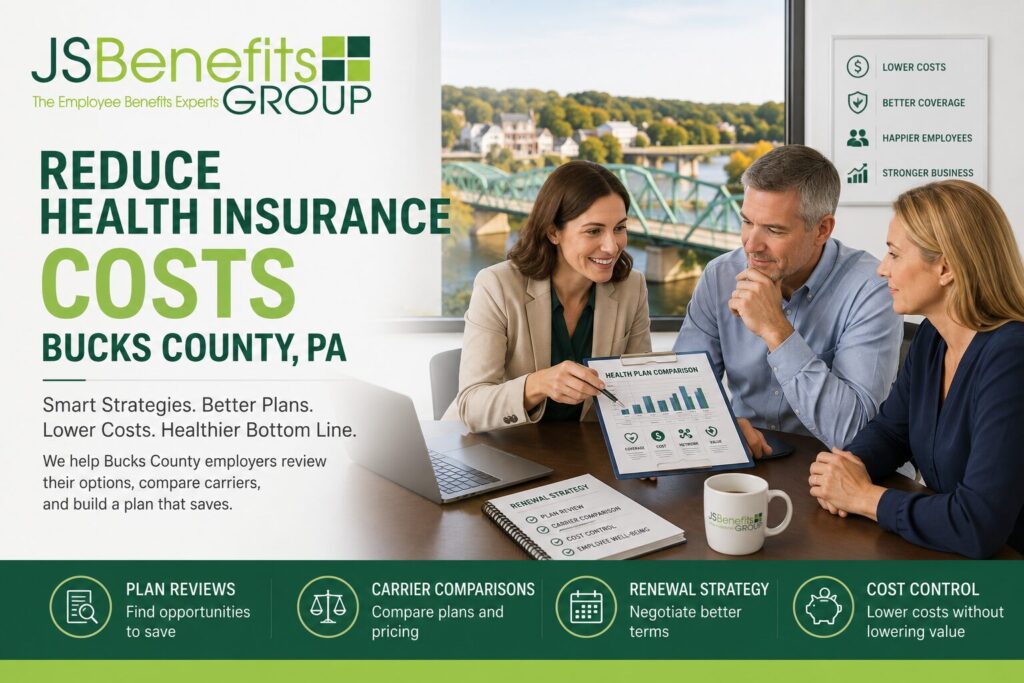

Quick Answer: Small businesses in Bucks County, PA may be able to reduce employee health insurance costs by reviewing plan design, comparing carrier options, adjusting contributions, improving employee education, and exploring level-funded or self-funded options when appropriate. The goal is not just to find the cheapest plan, but to build a smarter benefits strategy that controls costs while still giving employees coverage they can use.
Common Ways Bucks County Employers Can Manage Health Insurance Costs
| Cost-Control Strategy | What It Helps With |
| Renewal review | Shows whether your current increase is competitive |
| Carrier comparison | Helps identify better plan, pricing, or network options |
| Plan design review | Balances premium cost with employee out-of-pocket exposure |
| Contribution strategy | Helps manage employer spend and employee affordability |
| Employee education | Helps workers choose and use plans more effectively |
| Level-funded options | May provide more transparency and possible savings for the right group |
| Self-funded options | May offer more control for larger or growing employers |
The right strategy depends on your workforce, claims history, budget, provider needs, and renewal timing. For most employers, the best starting point is a full review of the current plan before making changes.
Start With a Full Review of Your Current Health Plan
Before making changes, you need to know what you already have.
A benefits consultant can review your current health plan, premiums, deductibles, copays, provider network, prescription coverage, employer contributions, employee participation, and renewal history. This helps identify whether your plan is still a good fit or if your business is paying for coverage that no longer matches your team’s needs.
This review should come before any major plan change. Without it, employers may focus only on the premium and miss other important factors like employee disruption, prescription costs, network access, contribution structure, or renewal timing.
Many employers renew the same plan year after year because it feels easier. The problem is that small increases can build up over time. A careful review can show whether your current plan is still competitive or whether other options may offer better value.
For Bucks County businesses, this review should also consider where employees live and receive care. Provider access in Newtown, Doylestown, Yardley, Langhorne, Levittown, Warminster, and the greater Philadelphia region can affect how useful a plan feels to employees.
Compare Carrier Options Before Renewal
One of the biggest mistakes employers make is accepting a renewal without shopping the market.
Insurance carriers may price plans differently based on plan design, network, funding model, group size, and other factors. Comparing options before renewal can help your business understand whether the increase is reasonable or whether another carrier may offer a better fit.
This does not mean switching carriers every year. It means making an informed decision.
A strong renewal review should answer questions like:
Is the current renewal increase competitive?
Are there similar plans with better pricing?
Would a different network reduce costs?
Are employees using the current plan as expected?
Would offering more than one plan option help?
Are there funding options worth exploring?
When you have clear answers, you can make a better decision instead of reacting to the renewal number.
If your renewal increase feels high or unclear, it may be worth reviewing your options before accepting the new rates. JS Benefits Group can help Bucks County employers compare plans, evaluate carrier options, and understand whether a different strategy may fit better.
Revisit Your Plan Design
Plan design has a major impact on cost.
A plan with low deductibles, low copays, and broad access may be attractive to employees, but it can also be expensive. A plan with lower premiums may reduce monthly costs but create higher out-of-pocket expenses for employees.
The right answer depends on your workforce.
Some businesses reduce costs by offering multiple plan choices. For example, one plan may have lower premiums and higher out-of-pocket costs, while another plan may offer richer coverage at a higher employee contribution. This gives employees more control based on their needs.
Other plan design changes may include reviewing deductibles, copays, coinsurance, prescription tiers, urgent care options, telehealth access, and provider networks.
The goal is to avoid overpaying for a one-size-fits-all plan that does not match how your employees actually use healthcare.
Review Employer Contribution Strategy
How much your business contributes toward employee premiums matters.
If the company contribution is too low, employees may not enroll or may feel the benefit is not valuable. If the contribution is too high, the business may be carrying more cost than it can sustain.
A benefits consultant can help you review your contribution strategy and compare it to similar employers. This can help you decide whether your current approach supports both your budget and your hiring goals.
Some employers contribute a set percentage. Others contribute a fixed dollar amount. Some use different contribution strategies for employee-only coverage and family coverage.
There is no single right answer for every business. The best approach depends on your budget, workforce, industry, and benefits goals.
Help Employees Choose the Right Plan
Employee education can also affect costs.
When employees do not understand their options, they may choose the wrong plan for their needs. Some may select a richer plan than they need, while others may pick a lower-cost plan without understanding the out-of-pocket risk.
Clear communication during open enrollment can help employees make better choices.
This may include explaining deductibles, copays, out-of-pocket maximums, provider networks, prescription coverage, HSAs, FSAs, telehealth, and how to compare total cost instead of only looking at the paycheck deduction.
Better education can reduce confusion, improve satisfaction, and help employees use their benefits more wisely.
Look at Prescription Drug Costs
Prescription costs can be a major part of health plan spending.
Employers often focus on medical premiums but overlook pharmacy costs. Depending on the plan, prescription drug coverage, formulary design, specialty medication rules, and pharmacy benefit manager arrangements may all affect total cost.
A benefits consultant can help review whether your plan’s prescription structure makes sense. They may look at generic options, mail-order programs, specialty drug management, preferred pharmacies, and pharmacy benefit manager transparency.
For some employers, even small pharmacy strategy changes can make a meaningful difference over time.
Consider Level-Funded Health Plans When Appropriate
Some Bucks County small businesses may be able to reduce or better manage costs by exploring level-funded health plans.
A level-funded plan is a type of health plan that blends parts of traditional fully insured coverage with parts of self-funding. Employers usually pay a set monthly amount that covers claims funding, administrative costs, and stop-loss protection.
Level-funded plans are not right for every business. They may be more attractive for groups with a healthy employee population and a desire for more cost transparency. They may also involve underwriting, reporting, and other considerations that should be reviewed carefully.
The benefit is that some employers may gain more insight into claims and potential savings opportunities compared with a traditional fully insured plan.
Before moving to a level-funded plan, your business should review risk, cash flow, employee needs, compliance responsibilities, and carrier options.
Explore Self-Funded Options for Larger or Growing Groups
Self-funded health plans may be another option for some employers, especially larger or growing businesses.
With a self-funded plan, the employer takes on more direct responsibility for paying employee health claims, usually with stop-loss insurance to help protect against large claims. This can offer more control, more data, and more flexibility, but it also brings more responsibility and risk.
Self-funding is not a simple cost-saving shortcut. It needs careful planning.
A benefits consultant can help determine whether your business is a candidate for self-funding, level-funding, or whether a traditional fully insured plan is still the better fit.
Use Wellness and Employee Advocacy Strategically
Wellness programs and employee advocacy support can also help control costs over time.
A wellness program may encourage preventive care, healthy habits, chronic condition support, and better use of healthcare resources. Employee advocacy can help workers understand claims, billing issues, provider questions, and plan details.
These programs do not replace good plan design, but they can improve the way employees use their benefits.
When employees know where to go for care, how to avoid unnecessary emergency room visits, and how to resolve billing questions, the plan can work better for everyone.
Avoid Cutting Benefits Without a Strategy
When costs rise, it may be tempting to reduce benefits quickly. That can backfire.
If employees feel their benefits are getting worse each year, morale and retention may suffer. This is especially important in Bucks County, where small businesses often compete with larger employers in the Philadelphia region.
Cost control should be thoughtful.
Instead of simply raising deductibles or shifting more cost to employees, review all available options. Sometimes the better answer is a new carrier, a different plan mix, improved employee education, better contribution design, or a new funding model.
The goal is to protect both your budget and your team.
Why Local Market Knowledge Matters in Bucks County
Health insurance is not just about premiums. Local provider access matters too.
A plan that looks affordable on paper may not work well if employees cannot access doctors, hospitals, or pharmacies near where they live and work. For employers in Newtown, Doylestown, Yardley, Langhorne, Warminster, Levittown, and nearby communities, network fit can make a big difference.
A local benefits consultant can help evaluate carrier options with Bucks County and the greater Philadelphia region in mind. This can help you avoid choosing a plan that creates frustration for employees.
Local knowledge also helps when your workforce includes employees in Pennsylvania, New Jersey, Delaware, Maryland, New York, or other nearby areas.
How JS Benefits Group Helps Bucks County Employers Control Costs
JS Benefits Group helps employers review employee benefits, group health insurance, renewals, compliance, HR support, plan design, and healthcare cost management. For Bucks County businesses, the goal is to help employers make smarter benefits decisions instead of simply accepting rising costs year after year.
Their process includes discovery, benefits analysis, benchmarking, strategy design, carrier market review, implementation, open enrollment support, and ongoing renewal guidance. This gives employers a clearer view of what their current plan is costing, where gaps may exist, and which options may create a better long-term strategy.
Whether your renewal is increasing, your employees are asking for better options, or your business is growing, JS Benefits Group can help you compare plans, understand your choices, and build a benefits program that supports both your budget and your workforce.
FAQs About Reducing Employee Health Insurance Costs in Bucks County, PA
Why does employee health insurance keep getting more expensive?
Health insurance costs can rise because of medical claims, prescription costs, carrier pricing, plan design, provider costs, and overall healthcare trends. Renewal increases may also depend on your group size, funding model, employee participation, and carrier.
Can a small business reduce health insurance costs without cutting benefits?
Yes. Some businesses can reduce or better manage costs by comparing carriers, adjusting plan design, offering multiple plan options, reviewing contributions, improving employee education, or considering level-funded options when appropriate.
Should I switch health insurance carriers every year?
Not always. Switching carriers can help in some cases, but it should not be done just for the lowest price. You also need to consider provider networks, employee disruption, prescription coverage, service quality, and long-term cost stability.
What is the best health insurance plan for a small business?
The best plan depends on your budget, employee needs, provider access, contribution strategy, and business goals. A plan that works well for one company may not be the right fit for another.
Can employee education really help control costs?
Yes. When employees understand how to choose and use their plan, they are more likely to make better healthcare decisions. Clear education can reduce confusion during open enrollment and help employees understand lower-cost care options.
Are level-funded plans good for small businesses?
Level-funded plans can be a good fit for some small businesses, but not all. They may offer more cost transparency and potential savings, but they should be reviewed carefully based on your group’s health, risk tolerance, cash flow, and compliance needs.
When should I review my employee health insurance plan?
You should review your plan well before renewal. Waiting until the last minute can limit your options. A proactive review gives you more time to compare carriers, evaluate plan designs, communicate with employees, and make a smarter decision.
Get Help Reducing Employee Health Insurance Costs in Bucks County, PA
Rising health insurance costs can put real pressure on your business, but you do not have to make renewal decisions alone. With the right strategy, you may be able to compare better options, manage costs, improve employee communication, and build a benefits plan that fits your company.
JS Benefits Group helps Bucks County employers review their current benefits, compare health insurance options, and make clearer decisions before renewal season.
If your premiums are rising or your current plan no longer feels like the right fit, schedule a free benefits analysis with JS Benefits Group.