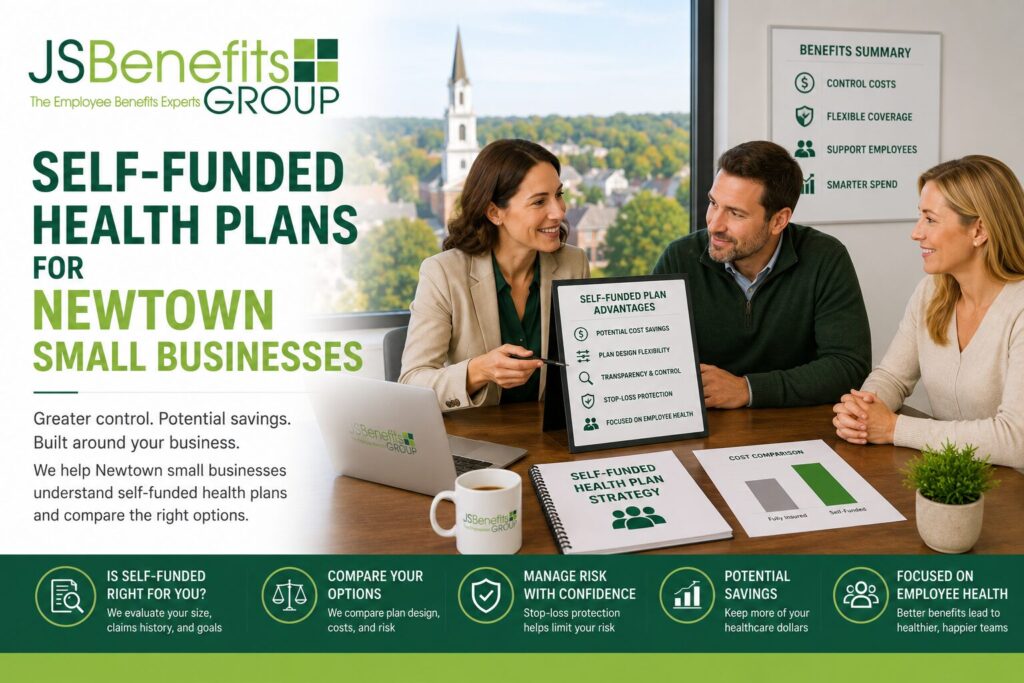

Quick Answer: Yes, self-funded health plans can be available for small businesses in Newtown, PA, but they are not right for every employer. These plans let employers pay employee health claims directly instead of paying a fixed premium to an insurance carrier. Many small businesses start by exploring level-funded plans because they offer some self-funded benefits with more predictable monthly costs.
What Is a Self-Funded Health Plan?
A self-funded health plan, also called a self-insured health plan, is a type of group health plan where the employer takes on the financial responsibility for employee healthcare claims.
With a traditional fully insured plan, your business pays a premium to an insurance carrier. The carrier takes on the claims risk and manages the plan based on its rules and pricing.
With a self-funded plan, your business pays for actual claims as they happen. A third-party administrator, often called a TPA, usually helps process claims, manage the provider network, handle plan administration, and support day-to-day operations.
Most self-funded employers also use stop-loss insurance. Stop-loss coverage helps protect the business from very high claims or unexpectedly high total claims during the plan year.
Are Self-Funded Plans Only for Large Companies?
Self-funded plans have traditionally been more common among larger employers. Larger companies often have more employees, more predictable claims patterns, and more financial room to handle claim fluctuations.
But self-funded and level-funded options are now more common for smaller employers than they used to be.
That does not mean every small business should move to self-funding. A company with only a few employees may have more risk because one large medical claim can affect the plan quickly. A company with a healthier and more stable group may have more options.
For small and mid-sized employers in Newtown, self-funding may be worth exploring if the company wants more control over healthcare costs, better claims insight, and a plan design that is not simply handed down by the insurance carrier.
Self-Funded vs. Level-Funded Health Plans
Many small businesses that ask about self-funded health plans are actually a better fit for a level-funded plan.
A level-funded health plan is a type of self-funded arrangement, but it is designed to feel more predictable for the employer. Instead of paying claims with large swings from month to month, the employer pays a set monthly amount. That payment usually includes administrative costs, stop-loss coverage, and a claims fund.
If claims are lower than expected, the employer may be able to receive money back depending on the contract. If claims are higher than expected, stop-loss coverage helps limit exposure.
For small businesses, this can make level funding a practical bridge between fully insured coverage and traditional self-funding.
| Plan Type | How It Works | Best Fit |
| Fully insured | Employer pays a fixed premium to an insurance carrier | Employers that want simplicity and less claims risk |
| Level-funded | Employer pays a fixed monthly amount with claims funding and stop-loss protection | Small to mid-sized employers that want more control with predictable payments |
| Self-funded | Employer pays actual claims directly and uses vendors to administer the plan | Employers with stronger cash flow, risk tolerance, and a long-term cost-control strategy |
| If Your Business Needs | Option to Review |
| Simple administration and less claims risk | Fully insured plan |
| Predictable monthly payments with more claims visibility | Level-funded plan |
| More control, more data, and stronger risk tolerance | Self-funded plan |
| A safer first step before traditional self-funding | Level-funded plan |
| A long-term cost-control strategy for a larger or growing group | Self-funded plan |
Why Small Businesses Consider Self-Funded Health Plans
Small businesses often look into self-funded health plans because fully insured premiums keep rising. Many employers feel like they pay more every year without getting more value.
Self-funding may give employers more visibility into what is driving costs. Instead of receiving a renewal increase with limited explanation, the business may be able to review claims trends, prescription costs, employee usage, and plan performance.
That information can help employers make smarter decisions.
A self-funded or level-funded plan may also offer more flexibility in plan design. This can help a business build benefits around its workforce instead of accepting a one-size-fits-all plan.
Potential Benefits of Self-Funded Health Plans
Self-funded health plans can offer several advantages when they are a good fit.
The first is transparency. Employers may gain better access to claims data and cost drivers. This can help identify trends and plan smarter for the next renewal.
The second is control. Employers may have more flexibility to adjust plan design, provider networks, pharmacy strategies, wellness programs, and employee support.
The third is possible savings. If claims are lower than expected, the employer may keep more of the savings instead of paying a fixed premium where the carrier keeps the difference.
The fourth is long-term strategy. Self-funding can help employers move from reacting to renewal increases to managing benefits with better data and planning.
Risks Small Businesses Should Understand
Self-funded plans can be helpful, but they also come with risk.
The biggest risk is claims volatility. If employees have unexpected medical needs, claims can be higher than expected. Stop-loss insurance can help protect the business, but employers still need to understand how the plan is structured.
There is also more responsibility. Self-funded plans may require more attention to compliance, reporting, plan documents, employee notices, privacy rules, and vendor management.
A self-funded plan is not something a small business should choose just because it sounds cheaper. It should be reviewed carefully based on the company’s size, cash flow, workforce health, plan history, and risk tolerance.
While an employee benefits consultant does not replace legal counsel, they can help employers understand the practical benefits, risks, and administrative needs involved in considering a self-funded or level-funded plan.
What Role Does Stop-Loss Insurance Play?
Stop-loss insurance is one of the most important parts of a self-funded health plan.
In a self-funded plan, the employer is responsible for paying claims. Stop-loss coverage helps protect the employer when claims are higher than expected.
There are usually two types of stop-loss protection.
Specific stop-loss helps protect the employer from a large claim tied to one person. Aggregate stop-loss helps protect the employer if total claims for the group go above a set amount.
For small and mid-sized employers, stop-loss coverage can make self-funding more manageable. It does not remove all risk, but it can help set limits around major claim exposure.
How Do You Know If Your Newtown Business Is a Good Fit?
A self-funded or level-funded health plan may be worth exploring if your business has steady enrollment, predictable cash flow, and a desire for more control over healthcare costs.
It may also be worth reviewing if your current health insurance renewal keeps increasing and you are not getting clear answers from your carrier.
A benefits consultant can help review key questions, such as:
| Question | Why It Matters |
| How many employees are enrolled in the plan? | Group size affects claims predictability and available options |
| How stable is your workforce? | Frequent employee changes can affect plan planning and administration |
| What has your claims history looked like? | Claims data helps estimate whether self-funding may be realistic |
| Can your business handle some claims risk? | Self-funded plans require financial readiness |
| Do employees need strong local provider access? | Network fit matters for employees across Newtown, Bucks County, and nearby areas |
| Do you want more control over plan design? | Self-funding may offer more flexibility than fully insured plans |
The right answer depends on your business. A plan that works well for one Newtown employer may not be right for another.
If your current renewal is increasing and you want more visibility into what is driving costs, this may be the right time to compare funding options. JS Benefits Group can help Newtown employers review fully insured, level-funded, and self-funded strategies before making a decision.
Why Local Guidance Matters in Newtown, PA
Newtown businesses often employ people who live across Bucks County, the Philadelphia region, and nearby parts of New Jersey. That makes provider access and network design especially important.
A local benefits consultant can help review whether a plan gives employees practical access to doctors, hospitals, pharmacies, and specialists in the areas where they actually live and work.
Local guidance also helps during renewal season. Instead of looking only at premium changes, a consultant can help compare funding options, carrier choices, employee costs, plan design, and long-term strategy.
For small and mid-sized employers, that kind of support can make the decision much clearer.
Common Mistakes to Avoid
One common mistake is choosing a self-funded plan only because the first-year numbers look lower. A lower estimate does not always mean the plan is the best fit.
Another mistake is ignoring stop-loss details. Employers need to understand how much risk they are taking and where stop-loss protection begins.
Some businesses also overlook employee communication. If the plan structure changes, employees need clear explanations. They should understand how the plan works, what changes for them, and where to go for help.
Finally, some employers do not review compliance requirements closely enough. Self-funded and level-funded plans may bring different responsibilities than fully insured plans. Those details should be reviewed before making a change.
How JS Benefits Group Helps Newtown Employers Review Self-Funded Options
JS Benefits Group helps Newtown employers review employee benefits, group health insurance, level-funded plans, self-funded health plans, healthcare cost management, renewals, and compliance support.
The team looks at your current plan, workforce needs, budget, carrier options, claims information when available, and long-term goals. From there, they can help determine whether a fully insured, level-funded, or self-funded strategy makes the most sense.
Their process includes discovery, benefits analysis, benchmarking, strategy design, carrier market review, implementation, open enrollment support, and ongoing renewal guidance. This helps small and mid-sized employers make informed decisions instead of reacting to renewal increases at the last minute.
For employers in Newtown, Bucks County, and the surrounding region, JS Benefits Group can help you understand your options, compare plan structures, and decide whether self-funding is a realistic path for your business.
FAQs About Self-Funded Health Plans for Small Businesses
Are self-funded health plans available for small businesses in Newtown?
Yes, self-funded and level-funded health plan options may be available for small businesses in Newtown. Availability depends on factors such as group size, employee participation, claims risk, carrier options, and underwriting.
Is a self-funded health plan the same as a level-funded plan?
Not exactly. A level-funded plan is a type of self-funded arrangement, but it is designed with more predictable monthly payments. Many small businesses explore level-funded plans before considering traditional self-funding.
Can a self-funded plan save money?
A self-funded plan may save money if claims are lower than expected and the plan is managed well. Savings are not guaranteed. Employers should review the risks, costs, stop-loss coverage, and administrative responsibilities before choosing this option.
What is stop-loss insurance?
Stop-loss insurance helps protect a self-funded employer from very high claims. It can apply to large claims from one person or to total group claims that exceed a set limit.
Are self-funded plans risky for small businesses?
They can be. Self-funded plans involve more financial responsibility than fully insured plans. Stop-loss insurance and level-funded structures can help manage risk, but employers still need to understand how the plan works.
What type of business is a good fit for self-funding?
A business may be a good fit if it has stable enrollment, reliable cash flow, a healthy or predictable claims profile, and a desire for more control over healthcare costs. A benefits consultant can help review whether the option makes sense.
Should I switch from fully insured to self-funded?
Not without a careful review. The right choice depends on your company size, budget, claims history, employee needs, provider access, and risk tolerance. Some businesses are better suited for fully insured coverage, while others may benefit from level-funded or self-funded options.
Get Help Reviewing Self-Funded Health Plan Options in Newtown, PA
Self-funded health plans can be available for small businesses in Newtown, but they should be reviewed carefully. The right plan can create more control and transparency. The wrong plan can create stress, confusion, and unexpected risk.
JS Benefits Group helps local employers compare fully insured, level-funded, and self-funded health plan options so they can make smarter benefits decisions.
If your renewal is increasing, your current plan feels too expensive, or you want to understand whether self-funding could work for your business, schedule a free benefits analysis with JS Benefits Group.