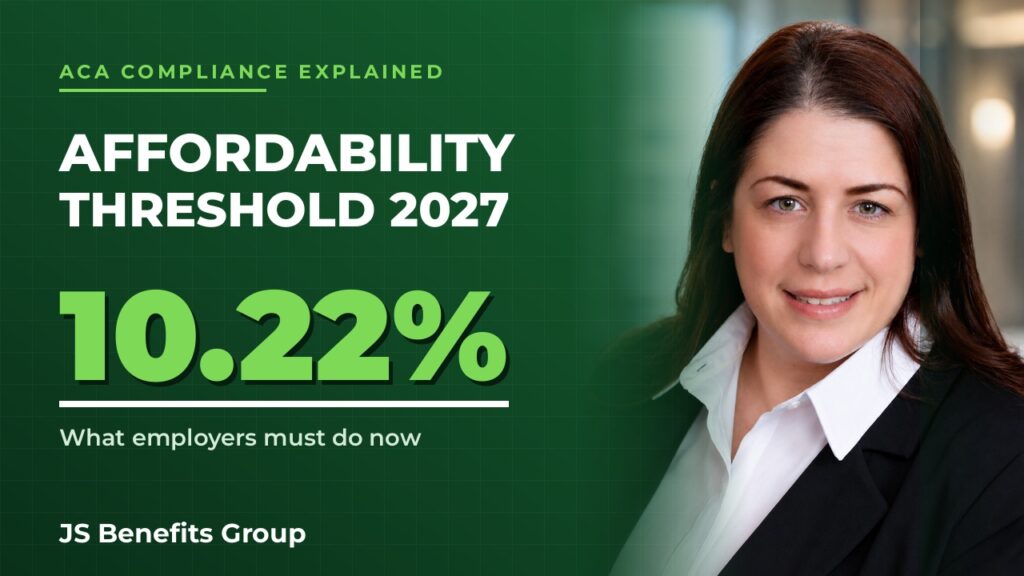

2027 ACA Affordability Threshold Increases to 10.22%
By Dawn Carlisle, JS Benefits Group Reviewed by Jennifer Schaefer, MBA, ChFC, CLU, RHU, REBC, SHRM-SCP
The IRS has released the 2027 Affordable Care Act affordability percentage, and for the first time it has crossed 10%.
For plan years beginning in 2027, applicable large employers must keep employee contributions for their lowest-cost, minimum-value, self-only health plan at or below 10.22% of household income.
At JS Benefits Group, we help employers across Pennsylvania, New Jersey, Delaware, Maryland, and New York stay compliant with the ACA while building benefit strategies that control cost and keep people from leaving.
Watch the 2027 ACA Affordability Video
What Changed for 2027
The affordability percentage rose to 10.22%, up from 9.96% in 2026.
That percentage decides whether an applicable large employer has offered affordable coverage under the employer mandate. If you are not sure whether your organization counts as an ALE, or how the rules apply to your workforce, our benefits consulting team can walk through it with you.
Which Health Plan Has to Pass the Affordability Test
The test applies only to your lowest-cost plan that provides minimum value, at the employee-only tier. It does not apply to dependent coverage.
Worth remembering during renewal: passing the IRS test and having a plan your employees consider competitive are two different questions. Plenty of plans clear the first bar and fail the second.
The Three Safe Harbors
Employers can use any of three affordability safe harbors:
- Federal Poverty Level
- Rate of Pay
- W-2 Wages
For calendar-year plans beginning in 2027, the Federal Poverty Level safe harbor caps the employee contribution at $135.92 per month.
Picking the right safe harbor is one of the more effective ways to reduce compliance risk, and it is frequently done on autopilot.
2027 Employer Shared Responsibility Penalties
The IRS raised the penalty amounts as well.
Section 4980H(a): $3,780 per full-time employee
Section 4980H(b): $5,670 per affected employee
Numbers at that scale are the reason affordability and plan design deserve a real review each year rather than a rollover.
The Mistake Many Employers Make
When the affordability percentage goes up, a lot of employers read it as permission to charge employees more.
That is not what the number is for. It establishes when penalties may apply. It says nothing about whether your plan helps you recruit, whether people stay, whether employees can actually afford care, or how you compare to the employer down the road competing for the same hires.
Compliance is the floor. Strategy is what happens above it.
Calculate Your ACA Exposure
Before open enrollment, run your potential employer mandate penalties through our free tool:
ACA Employer Mandate Penalty Calculator
Read the Full 2027 Guide
For a deeper walkthrough of the IRS guidance:
2027 ACA Affordability Threshold Guide
Reduce Healthcare Costs Without Cutting Benefits
ACA compliance is one piece of a benefits strategy. We also help employers with:
- Level-funded health plans
- Self-funded health plans
- Cost containment strategies
- Employee advocacy
- ACA and ERISA compliance
- Employee Navigator implementation
- Corporate wellness
- Executive benefits
Group Health & Employee Benefits Services
Need a Second Opinion?
Every workforce is different. Request a complimentary benefits analysis and our consultants will look for opportunities to lower your healthcare spend, tighten compliance, and strengthen what you offer.
Request Your Free Benefits Analysis