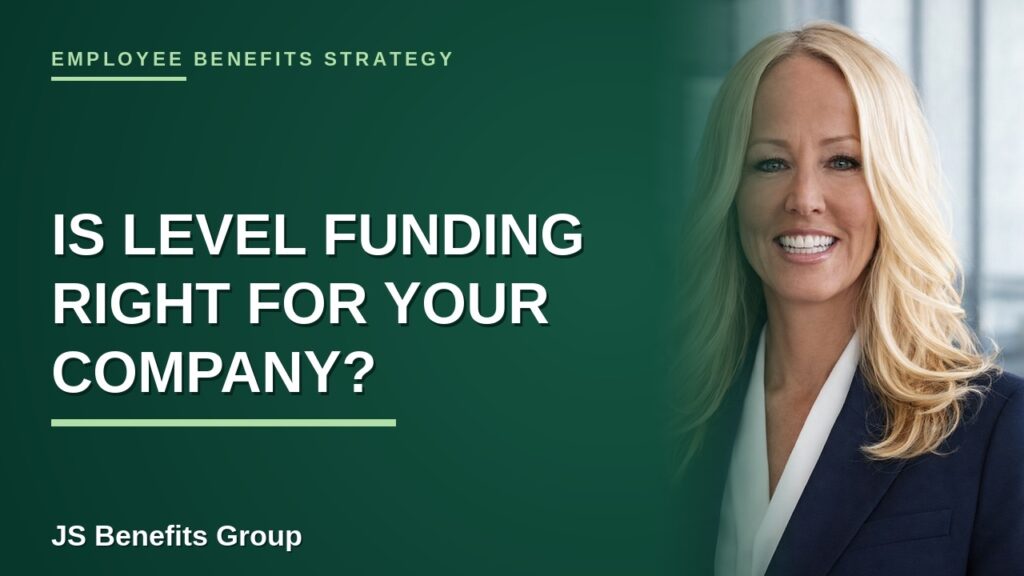

Jennifer Schaefer | Founder & CEO, JS Benefits Group
Is a level-funded health plan right for your company? In this video, Jennifer Schaefer explains what employers should consider when evaluating level-funded health insurance and whether it may be a fit for their business.
Watch the video below to learn more.
Is Level Funding Right for Your Company?
A level-funded health plan can provide an alternative to traditional fully insured group health insurance. But it isn’t automatically the right choice for every employer.
The right decision depends on factors such as company size, employee demographics, claims experience, current premiums, plan design, healthcare costs, employee contributions, and the company’s tolerance for risk.
What Is a Level-Funded Health Plan?
A level-funded health plan combines features of fully insured and self-funded health insurance. Employers generally make a predictable monthly payment that can include expected claims, administrative expenses, and stop-loss insurance.
The exact structure varies by carrier and plan.
What Are the Potential Advantages?
Depending on the employer and plan, level funding may provide:
- More predictable monthly budgeting
- Greater visibility into healthcare spending
- Stop-loss protection
- More flexibility in plan design
- Potential opportunities to manage healthcare costs
Savings are not guaranteed, and every employer should evaluate its own circumstances.
Is Level Funding Right for Every Company?
No.
Employers should look at their current health insurance costs, claims experience, workforce, plan design, financial objectives, and risk tolerance before deciding whether to move from fully insured coverage.
Can Level Funding Save My Company Money?
It can, but there is no guarantee.
Potential savings depend on the employer’s claims experience, employee population, plan design, underwriting, network, and the specific funding arrangement.
The best way to evaluate the opportunity is to compare the current plan with alternative funding strategies using actual employer data.
How Many Employees Do You Need?
There is no universal employee-count requirement. Eligibility and suitability depend on the carrier, state, underwriting requirements, employee population, and plan design.
Should Your Company Switch to Level Funding?
Not necessarily.
The goal shouldn’t simply be to find the lowest monthly premium. Employers should consider the total cost, financial risk, employee value, plan design, and long-term sustainability of the health plan.
An experienced employee benefits consultant can help employers compare fully insured, level-funded, and other health plan options.
How JS Benefits Group Can Help
JS Benefits Group helps employers evaluate group health insurance and employee benefits strategies, including level-funded health plans, plan design, healthcare cost containment, benefits administration, and employee benefits education.
Jennifer Schaefer, MBA, ChFC, CLU, RHU, REBC, SHRM-SCP, is Founder & CEO of JS Benefits Group and works with employers throughout Pennsylvania, New Jersey, Delaware, Maryland, New York, and beyond.
| Learn More About JS Benefits Group |
| https://jsbenefitsgroup.com/ |
| https://jsbenefitsgroup.com/employee-benefits-solutions/ |
| https://jsbenefitsgroup.com/level-funded-health-plans/ |
| Connect With JS Benefits Group |
| https://www.linkedin.com/company/js-benefits-group/ |
| https://x.com/JsBenefits |
| https://www.facebook.com/jsbenefitsgroup/ |
| Connect With Jennifer Schaefer |
| https://www.linkedin.com/in/jenniferschaefermba/ |
Watch the video on YouTube:
https://youtu.be/qE34fv4L2qU