
By Jennifer Schaefer, Founder & CEO, JS Benefits Group
If your company’s health insurance costs keep going up every year, I want to ask you a simple question:
Is your health plan really working as hard as it could for your business?
For many employers, the answer is no.
Not because anyone did anything wrong, but because the plan has been renewed the same way year after year without anyone stepping back to ask whether it still fits the company, the budget, and the employees it covers.
Watch the short video below, then keep reading to see what a closer look at your employee benefits strategy can uncover.
https://www.youtube.com/embed/JdUsoAzAkwM
Jennifer Schaefer, Founder & CEO of JS Benefits Group, discusses why employers should look beyond simply accepting their annual health insurance renewal.
The Pressure Employers Are Under Right Now
I work with employers every day who are facing the same challenges: rising healthcare costs, growing employee expectations, and pressure to offer competitive benefits without putting more money into the plan than necessary.
The cost side is not easing up.
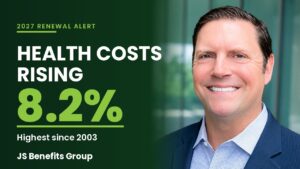
Preliminary results from Mercer’s 2026 National Survey of Employer-Sponsored Health Plans project that total health benefit cost per employee will rise an average of 8.2% in 2027, even after employers make planned cost-reduction changes. Without those changes, employers expect their current plans to cost about 11% more.
My colleague Rob Capone takes a closer look at what those increases could mean for employers in Employer Health Insurance Costs Are Projected to Rise 8.2% in 2027.
For employers already dealing with a significant renewal increase, we also explain what to do when your group health insurance renewal comes back too high.
The good news is that you may have more options than you realize.
Why “Accept the Renewal” Is Not a Strategy
At JS Benefits Group, we don’t believe your employee benefits strategy should simply be about accepting the renewal your insurance carrier gives you.
A renewal tells you what the carrier intends to charge.
It does not tell you whether your plan design still makes sense, where your claims dollars are going, or whether a different funding approach could serve your business better.
Before accepting a renewal, employers should be asking:
- What is actually driving our healthcare costs?
- Has our employee population changed?
- Is our plan design still appropriate?
- Are we getting competitive pricing?
- Have we looked at alternative funding arrangements?
- Are our pharmacy costs under control?
- Are employees getting enough value from the plan?
That is where a comprehensive employee benefits strategy becomes important.
Your health insurance renewal is one piece of the picture. It should not be the entire strategy.
What We Look At When We Review a Health Plan
When we review a health plan, we look at several factors together rather than evaluating the premium in isolation.
Plan Design
Deductibles, out-of-pocket maximums, copays, coinsurance, provider networks, plan tiers, and employer contributions all matter.
The question is not simply whether a plan is “good” or “bad.”
The question is whether the plan design makes sense for the company and the people who use it.
A plan with a lower premium may not necessarily be the best option if employees face significantly higher out-of-pocket costs.
Likewise, a richer plan may not be necessary if employees are paying for benefits they rarely use.
The right answer depends on the workforce.
Claims and Healthcare Costs
Understanding where the money is going is critical.
Depending on the plan and the information available, we may look at:
- High-cost claims
- Pharmacy spending
- Specialty medications
- Utilization patterns
- Emergency room usage
- Preventive care
- Chronic conditions
- Provider utilization
- Overall claims trends
Employers cannot effectively manage healthcare costs if they do not understand what is driving them.
This is especially important for employers considering a move away from traditional fully insured coverage.
Your Employee Population
Your workforce matters.
Age, family status, geographic location, employee demographics, compensation levels, and healthcare utilization can all influence which benefits strategy makes sense.
A benefits package that works well for a 40-person company may not be appropriate for a 400-person company.
And what works for an employer in one industry may not work for another.
That is why benefits strategy should be built around the employer and its workforce rather than simply copying what another company is doing.
Your Funding Arrangement
We also look at how the plan is funded.
For some employers, fully insured coverage remains the best option.
For others, level-funded health plans, self-funded arrangements, or captive strategies may provide additional flexibility and control.
The right funding strategy depends on the employer’s size, demographics, claims experience, financial position, risk tolerance, and goals.
Employee Benefits Strategies Worth Exploring
There is no one-size-fits-all solution.
Depending on your company’s situation, there may be several strategies worth exploring before your next renewal.
Level-Funded Health Plans
Level funding has become an increasingly popular option for small and mid-sized employers looking for an alternative to traditional fully insured coverage.
A level-funded arrangement generally combines a predictable monthly payment with stop-loss protection and claims funding. Depending on the plan and claims performance, employers may also have the opportunity to receive surplus funds.
For employers looking for greater transparency and an alternative to traditional fully insured plans, level-funded health plans may be worth evaluating.
Self-Funded Health Plans
With a self-funded health plan, the employer pays claims directly rather than paying a carrier’s full premium.
One of the potential advantages is greater access to claims information and more control over how the plan is designed and managed.
Self-funding is not appropriate for every employer, but for the right organization it can become an important part of a long-term healthcare strategy.
You can learn more about self-insured health plans and how they compare with traditional fully insured arrangements.
For employers interested in sharing risk with other organizations, captive health insurance strategies may also be an option.
HSA and HRA Strategies
Pairing a high-deductible health plan with a Health Savings Account can give employers another way to structure their benefits while helping employees save for qualified healthcare expenses.
A Health Reimbursement Arrangement can also be used to reimburse employees for eligible healthcare expenses, depending on the specific HRA structure.
The important part is making sure the employer contribution and overall plan design are realistic for the workforce.
A lower premium does not automatically mean a better benefits strategy if employees cannot reasonably afford to use the plan.
Plan Design and Cost Containment
Sometimes the biggest opportunities are found in the details.
That could mean restructuring plan tiers, encouraging employees to use high-value providers, improving employee education, reviewing pharmacy spending, or identifying opportunities to manage unnecessary healthcare costs.
Pharmacy is an increasingly important area for employers to evaluate. Our PBM management and transparency services can help employers take a closer look at pharmacy costs and the way their pharmacy benefit is structured.
Other strategies may include corporate wellness programs and employee advocacy services that help employees understand and use their benefits more effectively.
Together, these strategies can become part of a broader employee benefits and healthcare cost management strategy.
How Does Your Benefits Package Compare?
One of the most important questions an employer can ask is:
How does our benefits package compare with other employers?
Benchmarking can help you evaluate your plan costs, employee contributions, deductibles, plan design, and other important factors.
That information can give you a better starting point when you’re preparing for renewal or considering a change.
Use our free Employee Benefits Benchmark Calculator to get a better understanding of how your benefits compare.
You can also request a complimentary benefits analysis and have our team review your current strategy.
It’s Not Just About Cutting Costs
Here’s the important part:
The goal isn’t simply to spend less.
It is about finding the right balance between what your company can afford and the benefits your employees actually value.
A well-designed benefits program can help you:
- Control healthcare costs over the long term
- Make better use of your benefits budget
- Attract and retain employees
- Improve employee understanding of their benefits
- Provide meaningful healthcare options
- Make every benefits dollar work harder
This is why employee benefits have become much more than an HR expense.
Benefits can influence recruitment, retention, employee satisfaction, and the overall employee experience.
As we discuss in our guide on how to improve employee retention with HR and benefits strategies, the benefits you offer can have a direct impact on how employees view their employer.
Cutting benefits simply to hit a budget number can create another problem.
If employees become dissatisfied with their benefits and leave, the cost of turnover may outweigh the savings.
The goal should be to build a benefits strategy that works for both the employer and the employee.
Questions to Ask Before Your Next Renewal
Before you simply accept your next renewal, ask yourself:
- Do we know what is actually driving our healthcare cost increases?
- Have we compared our current funding arrangement with level-funded or self-funded alternatives?
- Is our plan design aligned with how our employees use healthcare?
- Are we getting full value from our pharmacy benefit?
- Are our employee contributions reasonable?
- Do our employees understand and appreciate the benefits we’re providing?
- Have we benchmarked our plan against comparable employers?
- Have we started the process early enough to consider alternatives?
If you cannot confidently answer most of these questions, your plan may deserve a closer look.
Frequently Asked Questions
When should we start reviewing our health plan before renewal?
Ideally, employers should begin reviewing their health plan approximately 90 to 120 days before the renewal date.
Starting early gives you time to gather claims information, evaluate plan design, compare funding alternatives, negotiate where appropriate, and communicate any changes to employees.
Waiting until the renewal is sitting on your desk can leave you with fewer options and less time to make a thoughtful decision.
Is level funding only for large companies?
No.
Level-funded health plans are often designed with small and mid-sized employers in mind.
Whether level funding makes sense for your company depends on factors such as group size, demographics, claims experience, risk tolerance, and overall objectives.
Will changing our health plan disrupt our employees?
Not necessarily.
Some changes happen primarily behind the scenes, such as funding arrangements or pharmacy strategies.
When employee-facing changes are necessary, good communication and employee advocacy can make the transition much easier.
Employees are more likely to appreciate their benefits when they understand how the plan works and where to go for help.
Does a benefits review cost anything?
No.
JS Benefits Group offers a complimentary benefits analysis to help employers understand their current plan and explore potential options before making a decision.
There is no obligation to change carriers or plans.
Take a Second Look Before You Renew
Your employee benefits should be more than an expense on your company’s income statement.
They should be part of your overall business strategy.
Before you simply accept your next renewal, take a second look.
Ask whether your current plan is still the right plan.
Ask whether your employees are getting the value they need.
And ask whether there are strategies you have not yet considered.
Your benefits strategy may have more room to improve than you think.
Request Your Complimentary Benefits Review
JS Benefits Group works with employers throughout Pennsylvania, New Jersey, Delaware, Maryland, New York, and nationwide.
Tell us about your current benefits program and our team can help you evaluate your options.
Request a Complimentary Benefits Review →
Or call (877) 355-6070.
About Jennifer Schaefer
Jennifer Schaefer is the Founder and CEO of JS Benefits Group and an employee benefits strategist who helps employers develop benefits programs designed to manage healthcare costs while supporting recruitment, retention, and employee satisfaction.
Jennifer is a Forbes Business Council member and contributor on employee benefits, healthcare costs, and workplace strategy.
Watch more of Jennifer’s insights on the JS Benefits Group videos page, explore our employee benefits case studies, or visit the HR & Benefits Blog.
Level Funded vs. Fully Insured Health Plans: What Employers Need to Know
How Claims Experience Impacts Your Group Health Insurance Renewal