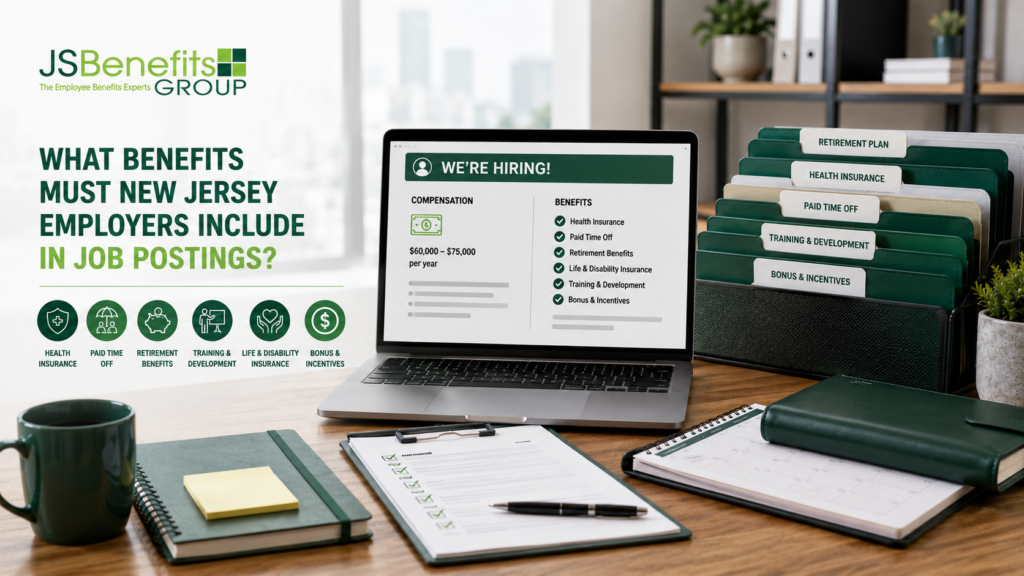
Quick Answer: New Jersey’s pay transparency law requires covered employers to include a general description of benefits and other eligible compensation programs in advertised new-job and transfer opportunities. The law does not require employers to offer a fixed list of benefits. NJDOL’s currently proposed, non-binding rules identify health, life and disability insurance, paid time off, training, and retirement or pension benefits as examples employers should describe when those benefits are offered for the position.
What Benefit Information Must a New Jersey Job Posting Include?
New Jersey’s pay transparency law, effective June 1, 2025, requires covered job and transfer postings to include the hourly wage or salary, or a pay range, along with a general description of benefits and other compensation programs for which the employee would be eligible.
The important phrase is general description. Employers do not need to copy an entire benefits guide into a job advertisement, but the posting should give applicants a meaningful idea of the benefits available with that position. Simply listing a salary range while leaving out available benefits may not satisfy the full disclosure requirement.
Which Benefits Should Employers Describe?
New Jersey law does not provide a fixed checklist of benefits that every job posting must contain. Instead, employers should describe the benefits actually offered with the position.
NJDOL’s proposed regulations provide examples of benefits that may need to be identified when applicable:
| Benefit or Compensation | What to Include |
|---|---|
| Health insurance | Identify it if available for the position |
| Life insurance | Include it when offered |
| Disability insurance | Include it when available |
| Paid time off | Describe available vacation, holiday, personal, or sick leave generally |
| Retirement or pension benefits | Identify the available retirement benefit |
| Training benefits | Include qualifying training benefits when offered |
| Bonuses | Disclose if the employee would be eligible |
| Commissions | Disclose if applicable to the position |
| Profit sharing | Identify it when the employee may participate |
These examples come from proposed NJDOL regulations that are currently non-binding, not from a statutory checklist requiring every employer to offer all of these benefits. The obligation is to accurately describe the benefits and other compensation programs that are actually available for the advertised position.
How Detailed Does the Benefits Description Need to Be?
The law calls for a general description, not a complete plan document. Employers generally do not need to place deductibles, copays, contribution percentages, waiting periods, retirement-plan formulas, or every PTO rule in the job posting.
The description should still be specific enough to tell an applicant what kinds of benefits are available. For example, stating that a position offers health insurance, paid vacation and sick leave, and a retirement plan is more informative than saying only “competitive benefits” or “great benefits offered.”
Employers should also make sure the description matches the position being advertised. If benefits vary by full-time or part-time status, hours worked, employee classification, or another eligibility requirement, the posting should not imply that a benefit is available when the person hired for that position would not qualify for it.
What Counts as Other Compensation Besides Benefits?
New Jersey treats benefits and other compensation programs as separate parts of the disclosure requirement. If an employee would be eligible for additional compensation beyond the listed wage or salary, that information should also be addressed in the posting.
NJDOL’s proposed rules identify bonuses, commissions, and profit-sharing arrangements as examples of other compensation programs. An employer should therefore review more than base pay and health benefits before publishing a posting. A sales position with commission eligibility or a position that participates in a bonus program may require that additional compensation to be disclosed as well.
Which Employers and Job Postings Are Covered?
New Jersey’s law generally applies to employers with 10 or more employees over 20 or more calendar weeks that do business, employ people, or take employment applications within New Jersey. Public employers are also covered, and certain employers headquartered outside the state may still fall under the law when they have the required connection to New Jersey.
The disclosure requirement applies to advertised new jobs and transfer opportunities, whether they are posted internally or externally. That means employers should review not only public job-board listings but also covered internal opportunities before they are distributed.
Temporary help service and consulting firms have a specific exception from the normal posting requirement. However, they still must provide required pay, benefits, and other compensation information when interviewing or hiring an applicant for a specific job opening.

What Should Employers Check Before Publishing a Job Posting?
Before a covered New Jersey job or transfer posting goes live, employers should review four items:
- Pay information: Include the hourly wage or salary, or an appropriate range.
- Benefits: Give a meaningful general description of benefits available for the position.
- Other compensation: Identify applicable bonuses, commissions, profit sharing, or similar programs.
- Accuracy: Make sure the description reflects what the employee hired for that specific position would actually be eligible to receive.
Employers should also avoid treating the benefits portion as optional. New Jersey has begun actively enforcing its pay transparency requirements. Violations can result in penalties of up to $300 for a first violation and $600 for subsequent violations, making benefits and other compensation important parts of a pre-publication review.
For employers managing these requirements alongside other workplace obligations, a broader review of HR administration can help keep benefits information and employment processes aligned.
Frequently Asked Questions About New Jersey Job Posting Benefits
If health insurance is offered for the position, employers should include it in the general benefits description. NJDOL’s proposed regulations specifically identify health insurance as an example of a benefit covered by the disclosure requirement.
Paid time off should generally be described when it is offered with the position. NJDOL’s proposed rules identify vacation, holidays, personal leave, and sick leave as examples of benefits that may be included in the disclosure.
Employers should avoid relying only on vague phrases such as “competitive benefits” or “great benefits.” A more useful general description identifies the main types of benefits actually available, such as health insurance, paid time off, or a retirement plan.
Yes. New Jersey’s disclosure requirements apply to advertised new-job and transfer opportunities posted internally or externally. Employers should therefore review covered internal postings as well as public job advertisements.
Temporary help service and consulting firms have a specific exception from the usual posting disclosure requirement. However, they must provide the required pay, benefits, and other compensation information when interviewing or hiring an applicant for a specific job opening.
What Should New Jersey Employers Review Before Posting a Job?
New Jersey employers should make sure every covered posting provides more than a salary range. It should also accurately describe the benefits available for the position and identify any other compensation programs for which the employee would be eligible. Because NJDOL’s detailed benefit examples currently come from proposed regulations, employers should also continue watching for changes to the state’s final guidance and rules.
Employers should also make sure the benefits described in job postings match what candidates are told during recruiting and what employees actually receive after hiring.
JS Benefits Group can help New Jersey employers review how benefits information fits into recruiting, HR administration, and their broader employee benefits strategy.